
8 Stardog Alternatives in 2026: Compared for AI Context, Reasoning, and Enterprise Fit
Stardog alternatives include d.AP, GraphDB, Neo4j, eccenca, TopBraid EDG, Amazon Neptune, Denodo, and TigerGraph. The right shortlist depends on the problem: delivering context to AI agents, managing formal knowledge models, federating data, governing terminology, or running graph analytics.

For agentic AI, the central question is how a platform supplies the right business context at runtime. Can an agent identify the relevant concepts, follow the right relationships, retrieve current facts, and respect access restrictions? A large graph alone does not answer those questions.
This guide compares eight alternatives across those requirements. Some overlap directly with Stardog. Others replace only part of its role or require a different architecture.
This comparison is published by digetiers, the company behind d.AP. It is a fit-based guide, not an independent performance ranking. Competitor descriptions draw on linked vendor documentation reviewed for this article. Features depend on the selected product, version, and deployment.
What is Stardog?
Stardog is a semantic platform that combines knowledge graph storage, ontology-based modeling, inference, and data virtualization. Its inference engine supports reasoning over declared knowledge. Its virtual graphs map external data into a graph view for querying. Stardog platform, Inference Engine, Virtual Graphs
Stardog also provides user-facing and AI capabilities. Voicebox supports natural-language interaction with enterprise knowledge, including generated queries and features for inspecting how answers were obtained. Designer supports modeling and mappings. Describing Stardog as a backend that always requires a separately built conversational interface would miss part of its current offering. Voicebox, Designer
Stardog belongs on a shortlist when an organization needs shared business definitions, semantic integration, formal inference, or graph-grounded AI. Looking for an alternative makes sense when another approach better fits the workload, governance model, operating environment, or implementation requirements.
For an AI context evaluation, compare the complete path from a business question to the context selected, the query executed, and the answer returned. The existence of an ontology or a chat interface is only a starting point.
Evaluating the alternatives: a simple framework
Use the same questions for Stardog and every alternative. Start with the task the agent must complete, then examine the architecture underneath it.
- Runtime context delivery. How does the platform select relevant concepts, relationships, constraints, and facts for a specific request? Can it expand context when a question crosses domains? Test missing context as well as irrelevant context.
- Explicit business meaning. Can teams define entities, relationships, and business conventions once and reuse them? Inspect supported ontology constructs and modeling boundaries. Standard names alone do not establish equivalent behavior.
- Reasoning and query correctness. Separate formal inference from an agent's use of context. Test supported entailments, generated queries, ambiguity handling, and the faithfulness of answers independently.
- Explainability and evidence. Can a reviewer inspect the context used, the executed query, and the supporting results? Can the applicable model and source state be identified? An explanation written by a language model is not sufficient evidence.
- Accessibility and expert effort. What can domain experts maintain themselves? Where are data engineers, ontology specialists, or developers still needed? Include the cost of agreeing on business definitions.
- AI and agent integration. Which interfaces are supported in the selected package? Can existing agents consume context with identity and permissions preserved? Test document retrieval separately if the use case includes unstructured sources.
- Federation and freshness. Which sources are queried live, cached, synchronized, or materialized? How are cross-source joins handled? Runtime context assembly and real-time source freshness are different capabilities.
- Governance and operationalization. Who approves changes to models, mappings, and rules? How are access restrictions enforced? If agents can trigger actions, where are those actions validated before a source system changes?
- Deployment and scalability. Assess the available deployment model, data location, concurrency, recovery, and operational ownership. Measure data volume separately from ontology size and structural complexity.
- Time to value, total cost, and exit. Include modeling, integration, infrastructure, licenses, model usage, operations, and migration. Test whether exported knowledge assets can be reused outside the original runtime.
Decision shortcuts
- Need to investigate ontology-guided context assembly for agents? Include d.AP alongside Stardog and other semantic platforms with agent capabilities.
- Need an RDF database with a defined inference regime? Compare Stardog and GraphDB against the exact rules and query workload.
- Need property-graph applications or graph algorithms? Evaluate Neo4j and TigerGraph. Include the cost of translating any existing RDF semantics.
- Need enterprise knowledge modeling and governance? Evaluate eccenca and TopQuadrant, including how governed models reach consuming applications.
- Need managed RDF storage within AWS? Evaluate Neptune Database and the additional services required around it.
- Need a logical access layer across operational sources? Compare Denodo and Stardog using representative joins, freshness requirements, and access policies.
Decision matrix: Stardog alternatives compared
The matrix summarizes architectural emphasis. It does not assign unmeasured capability scores. Product evidence and scope qualifications appear in the linked profiles below; the Stardog baseline is documented above.
| Platform | Relevant starting point | Context or reasoning approach to examine | Decisive evaluation question |
|---|---|---|---|
| Stardog, baseline | Semantic integration and graph-grounded AI | Inference, virtual graphs, and Voicebox | Does the configured platform provide complete, correct context for the target questions? |
| d.AP | Explicit business meaning for agents | Schema anchors, structural context expansion, and ontology-guided agent work | Does selective context assembly hold up across the organization's large and complex models? |
| GraphDB | RDF data management and inference | Rule-based inference plus graph and AI tooling | Do the selected rule set and context workflow meet the workload's needs? |
| Neo4j | Property-graph applications and analytics | Cypher-based graph access and graph-grounded AI | Does the property-graph design preserve the business semantics the application needs? |
| eccenca | Enterprise semantic integration | Governed knowledge models, mappings, and consumption workflows | How much expert work is required to create and maintain reusable context? |
| TopQuadrant | Semantic governance and authoritative context | Governed ontologies and context delivery in the selected offering | Can approved definitions reach agents with the required permissions and update behavior? |
| Neptune Database | Managed graph storage on AWS | RDF/SPARQL with separately selected AI and semantic components | Which Stardog functions must be supplied elsewhere in the architecture? |
| Denodo | Logical data access and virtualization | Semantic abstraction and AI access over connected sources | Do federation behavior and semantic expressiveness fit the agent workload? |
| TigerGraph | Graph algorithms and connected-data applications | GSQL, graph analytics, and AI integrations | Do measured algorithmic benefits justify any modeling and migration changes? |
The best Stardog alternatives in 2026: fit by requirement
“Best” here means best suited to a defined requirement. The numbered order is not a benchmark ranking.
1. d.AP by digetiers
Best for: Teams evaluating how explicit enterprise knowledge can guide agents across large or complex business models.

An AI context platform makes business knowledge available to agents at the point of use. d.AP approaches this through an explicit knowledge layer: a formal ontology describes business meaning and relationships, rather than leaving each application to infer those conventions independently.
The concrete focus is selective context assembly. d.AP identifies relevant schema anchors through similarity search, then expands their context along the declared ontology structure. The structural expansion is deterministic. The agent can also extend its neighborhood along declared relationships when additional context is needed.
This mechanism targets an important scaling problem: an agent should not have to receive the entire enterprise ontology for every question. However, selecting a smaller context does not guarantee that every required concept is present. The deterministic expansion step also does not make the entire language-model workflow deterministic or error-free.
Key similarities vs. Stardog
- Both approaches use explicit semantic models to support work with enterprise knowledge.
- Both belong in an evaluation of graph-grounded AI.
- Both require accurate source mappings and maintained business definitions. Domain alignment remains expert work.
Key differences
The useful distinction is the mechanism to evaluate, not “AI versus no AI.” d.AP's focus is how ontology structure guides context assembly and agent work. Stardog documents both an inference engine and Voicebox workflows. These capabilities should be assessed separately. Stardog Inference Engine, Voicebox
d.AP uses a restricted OWL profile as declared structure for its approach. It is not presented here as a full OWL 2 DL reasoner or as a substitute for every query-time inference behavior in Stardog.
The platform advantage
d.AP combines a product approach with a method for defining business meaning. Its architecture separates the enterprise knowledge model from the source systems that hold operational facts. Domain models are intended to reuse explicit identifiers and relationships rather than embed competing definitions in each consuming application.
For example, “customer” may mean a contracting legal entity in one system and an account in another. The relevant work is to make that distinction explicit and determine which meaning a question requires. A graph connection by itself does not resolve the business ambiguity.
Portable by design
Customer ownership of explicit knowledge assets is a design principle of d.AP. The relevant assets include models and the mappings, rules, and queries needed to interpret them.
Portability must still be tested against the selected implementation. Exporting an ontology is different from reproducing its behavior elsewhere. The runtime, agent implementation, and editing tools are separate from the knowledge assets and should not be assumed to transfer with them.
Stardog and other standards-based platforms also support open semantic formats. The comparison should therefore test actual reuse, not claim that openness is unique to d.AP.
Traceable outputs
For a d.AP evaluation, require an evidence chain that connects an answer to the context used, the executed query, and the supporting source results. Where historical reconstruction matters, include the applicable model and mapping state.
Treat this as an acceptance criterion to demonstrate in the proposed deployment. Ontology grounding alone is not proof that every output has complete provenance or that every generated query is correct.
When to choose d.AP over Stardog
Choose d.AP if a representative evaluation shows that its ontology-guided context approach meets the organization's requirements better, particularly across large models and cross-domain questions. Compare context completeness, query correctness, latency, maintenance effort, and cost per correct answer.
The context mechanisms described above are implemented, but this article does not establish independently benchmarked superiority over Stardog. If the requirement is specifically to preserve an existing inference regime, validate that compatibility before selecting d.AP as a replacement.
Website: digetiers
2. GraphDB, from Graphwise / Ontotext
Best for: Teams that need RDF data management, SPARQL, and a defined rule-based inference configuration.
GraphDB combines an RDF database with inference and management tools. Its current product offering also includes AI-related capabilities. It should not be treated as a database with no user interface or AI support. GraphDB product overview
Key similarities vs. Stardog: RDF/SPARQL, semantic models, inference, and tooling for working with enterprise graphs.
Key differences: GraphDB documents forward-chaining inference with supported rule sets. Stardog documents its own query-time reasoning approach. The relevant comparison concerns supported semantics, update behavior, query behavior, and operating costs. Separately distinguish the GraphDB component from additional Graphwise platform capabilities. GraphDB, Stardog Inference Engine
Choose GraphDB over Stardog when: The selected GraphDB configuration better fits the required entailments, RDF workload, tooling, and operating model. If AI context is the primary goal, test the complete agent workflow rather than infer its quality from database features.
Website: GraphDB
3. Neo4j
Best for: Teams building property-graph applications, relationship analytics, and graph-grounded AI around Cypher.
Neo4j's current offering spans graph databases, analytics, and agent capabilities. Its property-graph model is a material architectural difference from Stardog's RDF-based approach. The comparison is not “modern AI platform versus traditional semantic database.” Neo4j products
Key similarities vs. Stardog: Connected-data querying, graph exploration, and support for AI applications that use graph context.
Key differences: Cypher and the property-graph model shape how knowledge is represented and queried. Existing RDF ontologies, entailments, and SPARQL queries require a deliberate compatibility or translation strategy. They should not be assumed to retain identical behavior after conversion.
Choose Neo4j over Stardog when: A property-graph application and its ecosystem fit the workload better, and the required semantic behavior can be implemented and maintained. Measure performance on representative queries instead of assuming that one graph model is universally faster.
Website: Neo4j
4. eccenca Corporate Memory
Best for: Organizations combining semantic integration with enterprise knowledge modeling and governance.
Corporate Memory supports knowledge models, data integration, visual mappings, and governed access to enterprise knowledge. Its scope is broader than a single industry or supply-chain use case. eccenca Corporate Memory
Key similarities vs. Stardog: Standards-based enterprise knowledge graphs, ontology-based integration, and reusable semantic access to data.
Key differences: Evaluate the modeling, mapping, governance, and consumption workflow as a whole. The practical question is how business experts and technical teams collaborate, then make maintained knowledge available to applications and agents.
Choose eccenca over Stardog when: Its integrated modeling and governance workflow better matches organizational responsibilities and implementation needs. Demonstrate runtime context delivery on the intended agent stack rather than infer it from the presence of a governed graph.
Website: eccenca Corporate Memory
5. TopBraid EDG / TopQuadrant
Best for: Teams whose primary need is governed ontologies, taxonomies, reference data, and shared business definitions.
TopBraid EDG is associated with semantic data governance and knowledge modeling. TopQuadrant's current TQ Data Foundation presentation also covers authoritative context delivery to agents. Buyers should identify the exact product and package being evaluated rather than apply an older “taxonomy tool only” description to the whole offering. EDG documentation, TQ Data Foundation
Key similarities vs. Stardog: Explicit semantic models, open knowledge representation standards, and enterprise knowledge integration.
Key differences: TopQuadrant places substantial emphasis on how experts create, approve, and maintain authoritative definitions. Its current offering also describes agent interfaces. Governance depth and runtime delivery should both be demonstrated in the selected package. TQ Data Foundation
Choose TopQuadrant over Stardog when: The governing and publishing of shared knowledge assets is the central requirement, and the proposed configuration supports the necessary consumption patterns. Test representative steward tasks instead of accepting a blanket “best interface” claim.
Website: TopQuadrant
6. Amazon Neptune Database for RDF workloads
Best for: Organizations seeking managed RDF/SPARQL storage within an AWS architecture.
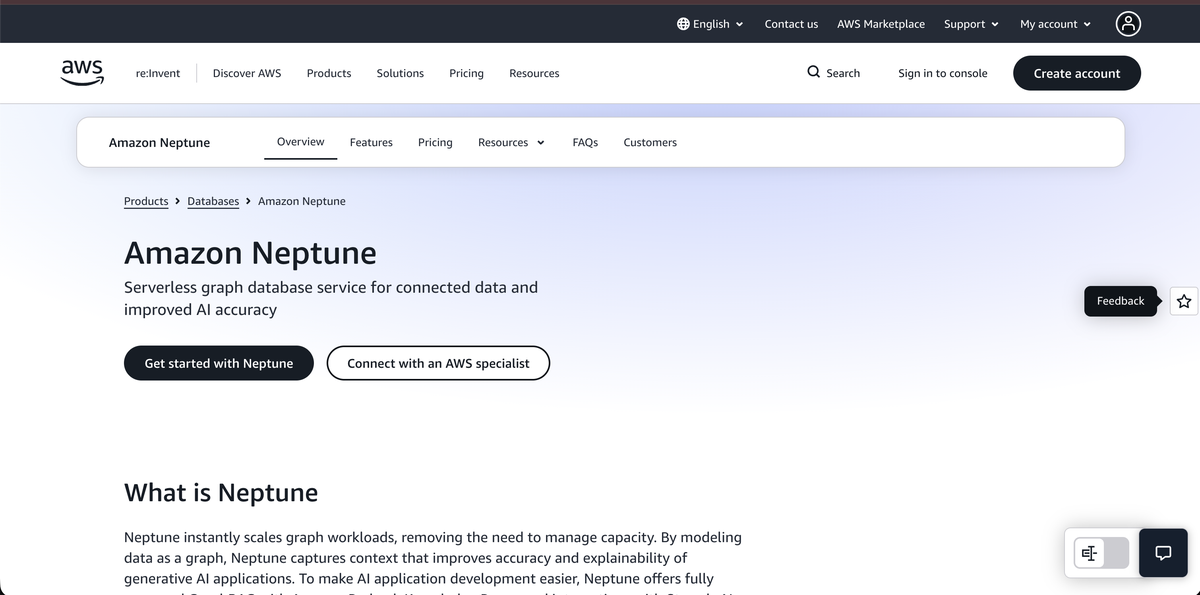
Neptune Database supports RDF/SPARQL and property-graph workloads. AWS manages database operations such as backups and availability features. Neptune Analytics and other AWS AI services are distinct components whose capabilities should not automatically be attributed to the RDF database. Amazon Neptune FAQ
Key similarities vs. Stardog: Storage and querying of connected data, including RDF access through SPARQL.
Key differences: Neptune Database is a managed graph database service. Replacing a broader Stardog implementation requires accounting for ontology tooling, inference requirements, federation, agent context, and governance separately. SPARQL support alone does not establish full feature equivalence.
Choose Neptune over Stardog when: AWS integration and managed database operations are priorities, and the surrounding architecture covers the remaining requirements. Estimate the full solution cost, including connected services and engineering, rather than assuming that managed storage guarantees the lowest total cost.
Website: Amazon Neptune
7. Denodo
Best for: Organizations prioritizing logical data access and federation across heterogeneous sources.
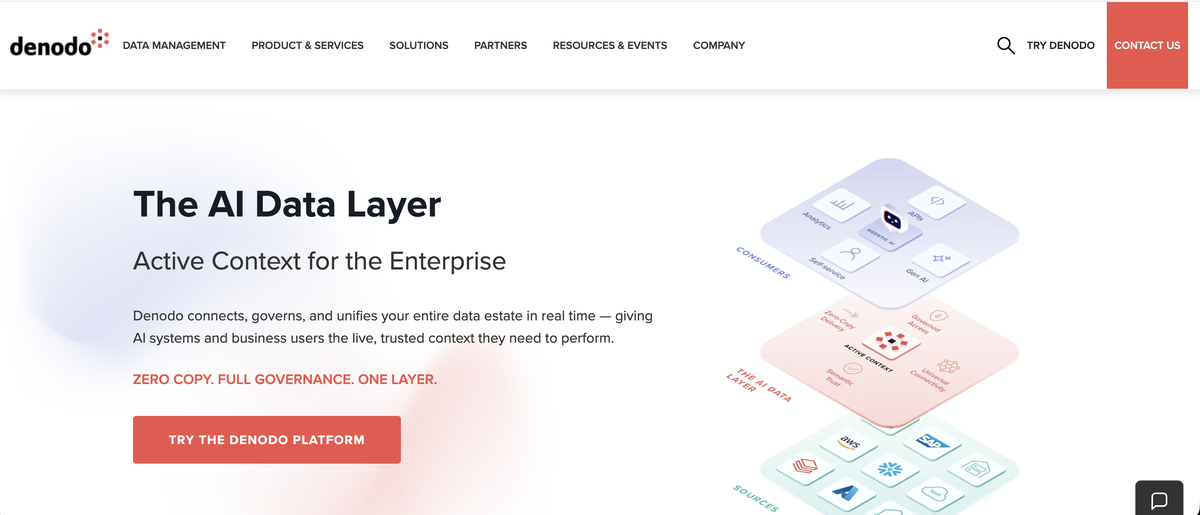
Denodo combines data virtualization with semantic, governance, and AI capabilities. Its current platform positioning includes an AI data layer for context. Describing it as “SQL only” or as having no semantics would be inaccurate. Denodo Platform
Key similarities vs. Stardog: An abstraction over distributed data, source connectivity, and support for business-oriented access without requiring every workload to use a single physical store.
Key differences: The comparison should examine the semantics represented by each platform, how queries are executed across sources, and how context reaches agents. A logical semantic layer and an ontology-based inference system are not automatically equivalent. Denodo also supports caching and selective materialization, so “no data movement” should not be treated as a universal deployment property. Denodo Platform
Choose Denodo over Stardog when: The main challenge is governed access across operational sources and Denodo's execution model meets the workload. Verify formal modeling and inference requirements separately if the application depends on them.
Website: Denodo
8. TigerGraph
Best for: Teams whose applications depend on graph algorithms and GSQL-based connected-data processing.
Best for: Teams whose applications depend on graph algorithms and GSQL-based connected-data processing.
TigerGraph offers a graph database, analytics, visual development tools, and AI-related capabilities. Its product scope is broader than a low-level engine for technical users alone. TigerGraph product overview
Key similarities vs. Stardog: Connected-data applications, graph queries, and graph-supported AI use cases.
Key differences: TigerGraph's graph model, GSQL, and algorithmic workflows differ from an RDF/SPARQL and ontology-inference approach. Migrating requires examining the business meaning encoded in the existing model, not just transferring vertices and edges.
Choose TigerGraph over Stardog when: Representative tests show that its graph algorithms and application model better meet the requirements. For fraud, dependency analysis, or network analysis, measure the actual workload. High data volume alone does not establish which platform is the better choice.
Website: TigerGraph
Use-case matchups
Semantic data management
Starting shortlist: Stardog and GraphDB; add eccenca when integrated modeling and governance are central.
For RDF workloads, compare ontology profiles, inference behavior, update costs, and SPARQL results. If managed AWS storage is the primary need, add Neptune Database while accounting for semantic functions supplied elsewhere.
Knowledge graph and ontology for agents
Starting shortlist: d.AP and Stardog, with Graphwise, eccenca, and TopQuadrant assessed for the required package and workflow.
Use questions that cross business domains and contain ambiguous terms. Test whether the platform selects the necessary ontology context, retrieves the correct facts, and asks for clarification where needed.
This is the most relevant setting for a Stardog vs. d.AP evaluation. For large knowledge models, measure context selection and answer correctness separately from graph storage capacity. Include unstructured sources as a separate test if documents are part of the required context.
Data federation and virtualization
Starting shortlist: Stardog and Denodo; evaluate other candidates against the exact source estate.
Compare supported sources, mapping behavior, query pushdown, cross-source joins, caching, and policy enforcement. Do not rank “native federation” against “connectors” without examining execution: a source connector and a federation engine describe different parts of the architecture.
For d.AP, make the required source-access modes and freshness behavior explicit in the evaluation. Do not infer them from its context-assembly mechanism.
Governance and taxonomy
Starting shortlist: TopQuadrant and eccenca; retain other platforms where their governance workflow meets the requirements.
Ask domain experts to propose a term, resolve a conflict, approve a change, and inspect its downstream effect. The outcome should establish who owns the definition and how consumers receive the approved version.
Migration and coexistence patterns
A Stardog alternative may replace the database, the semantic tooling, the agent context workflow, or several of these layers. Decide which responsibility is changing before designing the migration.
Replacing Stardog vs. complementing it
Both are valid architecture options. Neither is inherently the more common or safer route. The choice depends on the current implementation, the target platform, and the evidence from a pilot.
Full replacement
Full replacement makes sense when the target architecture satisfies the required functions and the benefit justifies migration cost and risk. That may involve operations, commercial terms, application fit, or context delivery.
It should not be framed as choosing business answers over semantic correctness. Correct business answers depend on preserving the meaning of the underlying information.
What migration looks like
- Inventory existing assets. Record ontologies, instance data, named graphs, mappings, rules, queries, source connections, access controls, and consuming applications. Identify dependencies on specific inference settings or extensions.
- Export and inspect compatibility. Stardog already uses RDF-based standards. The task is to preserve identifiers and meaning, then check the target's supported profiles and behavior.
- Reuse mappings where compatible. Stardog supports R2RML and SMS2. Its tooling can translate mappings in supported cases, but extended expressions and nonrelational mappings need separate assessment. Do not rebuild everything by default or promise lossless conversion of every mapping. Virtual Graphs, Virtual Graph Mappings tutorial
- Test equivalent behavior. Compare reference queries, expected entailments, constraints, access restrictions, and representative agent answers. A valid import is not proof of semantic equivalence.
- Move one domain or workflow first. Run in parallel, measure differences, and maintain a rollback path. Move consumption first only where the necessary interfaces and permissions have been proven.
- Retire the old component after acceptance. Confirm operational ownership, recovery procedures, and downstream dependencies before removing it.
Complementing Stardog
Coexistence can be useful when an existing Stardog deployment already performs required functions and a separate component adds a demonstrated benefit.
For example, a team might retain existing graph services while testing a different context workflow for one agent. The integration must preserve model interpretation, authentication, permissions, and source freshness. An available SPARQL endpoint does not by itself prove that two platforms can be combined without additional work.
A d.AP-plus-Stardog design is therefore an architecture option to validate, not a preverified integration promised by this article. It should not depend on an unsupported assumption that Stardog handles large models while d.AP cannot, or vice versa.
Concrete example
Consider a hypothetical manufacturer asking: “Which open orders depend on suppliers whose current certification expires before the planned shipment?”
A pilot must connect the meaning of supplier, certification validity, order status, and shipment date. It must also define how to treat missing certifications and multiple shipments. Begin with one domain slice and a reference answer set.
Keep the existing source and graph services during the test if the interfaces allow it. Compare the current agent workflow with the proposed one. Check which concepts were selected, which joins and date conditions were applied, and whether restricted orders were excluded. Expand only after both answer behavior and operating responsibilities are accepted.
Preserving ontology-level knowledge
The migration target is usable business knowledge, not just an exported graph file.
What typically goes wrong
Common risks to test for include lost identifiers, altered inference assumptions, mismatched null or missing-value behavior, and changes to how source records become graph entities. A query can still run while returning a different business result.
Treat these as migration risks, not as claims that one named vendor necessarily causes them.
What good preservation looks like
The target retains or explicitly translates the definitions and relationships that matter. Reused mappings produce the intended entities. Required rules and constraints still behave correctly. Reference queries and permission tests return the accepted results.
For RDF-to-property-graph migrations, document the semantic translation explicitly. For RDF-to-RDF migrations, still test profiles, functions, inference settings, and operational extensions.
Semantic ownership and governance risks
Changing platforms can leave ownership unclear even when the technical migration succeeds. Decide who approves definitions, maintains mappings, resolves cross-domain conflicts, and authorizes changes to rules.
Critical questions to answer
- Which team owns each business definition and its identifier?
- Which assets can be exported, and which require the original runtime?
- Who approves a model change before agents use it?
- How are source data permissions preserved through the context layer?
- Can a past answer be reconstructed to the degree the use case requires?
- Who validates an agent-triggered action before a source system changes?
Common failure modes
Watch for multiple copies of a definition evolving independently, permissions applied only in the user interface, and business logic left in undocumented prompts or application code. Another risk is testing exports without testing whether a second system can use them.
Recommendations
Assign owners to semantic assets. Version the artifacts needed to reproduce the agreed behavior. Maintain reference questions and expected results. Test a small export-and-reuse case before a wider commitment. Keep domain experts involved in changes that affect meaning.
Frequently asked questions about Stardog alternatives
What is the best Stardog alternative for enterprise AI?
The best fit depends on the role the platform must perform. Shortlist d.AP for explicit business knowledge and ontology-guided AI context. Consider GraphDB for RDF storage and rule-based inference, eccenca or TopQuadrant for semantic modeling and governance, and Neo4j or TigerGraph for property-graph applications and analytics. Compare candidates using the same business questions, source data, and acceptance criteria. The profiles above explain each option's architecture and supporting documentation.
How does d.AP differ from Stardog?
d.AP is an AI Context Platform focused on making shared business meaning usable by agents. It selects relevant schema anchors, expands context through declared ontology relationships, and supports further agent exploration along those relationships. Stardog combines semantic storage, inference, virtual graphs, and natural-language access through Voicebox. The key distinction to evaluate is how each platform turns a business question into usable context. d.AP uses a restricted OWL profile for context and query generation; workloads that depend on Stardog's inference behavior need a separate compatibility assessment. Stardog Inference Engine, Virtual Graphs, Voicebox
Which Stardog alternatives support RDF, OWL, and SPARQL?
GraphDB is a direct candidate for RDF/SPARQL workloads with OWL-related inference through supported rule sets. d.AP uses RDF, an OWL-based domain model, and SPARQL as its knowledge foundation. Amazon Neptune Database supports RDF/SPARQL storage and querying, with inference requirements assessed separately. Distinguish storing an OWL model from executing the entailments it describes: support for these standards does not imply identical reasoning behavior. Check the specific constructs, queries, and rules your application uses. GraphDB, Amazon Neptune FAQ
Can existing Stardog ontologies and mappings be reused?
RDF-based ontologies and SPARQL queries can be reused where the target supports their constructs and dependencies. Preserve identifiers, then test the expected query results and inference behavior. Source mappings need their own compatibility check: Stardog supports R2RML and SMS2, and its tooling can translate mappings in supported cases. Custom expressions, nonrelational mappings, and runtime-specific functions may need adaptation. Start with representative assets to determine what transfers directly and what requires changes. Virtual Graphs, Virtual Graph Mappings tutorial
Should an organization replace Stardog or complement it?
Replace Stardog when the target covers the required responsibilities and the benefit justifies migration. Complement it when existing graph services remain useful and another component adds value, such as a different context-delivery workflow. For either approach, specify who owns definitions, mappings, permissions, and updates. Test one domain first. A proposed d.AP–Stardog combination requires integration design and validation rather than assuming a ready-made connection.
What should teams evaluate when choosing a knowledge graph platform for AI agents?
Evaluate the complete path from a business question to the returned answer. Check which concepts and relationships are selected, whether queries retrieve the right facts, and how ambiguity and access restrictions are handled. Include cross-domain questions, changing source data, and incomplete information. Measure context coverage and answer correctness separately from latency and graph size. Also assess the work needed to maintain definitions and reuse knowledge assets outside the platform.
Conclusion and recommendation
Choose a Stardog alternative against the function that needs to improve. RDF inference, semantic governance, data virtualization, graph analytics, and agent context delivery require different tests.
For an agent-context requirement, include d.AP in the shortlist when ontology-guided context assembly is central, especially across large or complex knowledge models. Compare it fairly with Stardog's current semantic and AI capabilities. Require evidence for context completeness, correct queries, supported answers, permissions, and operating cost.
To evaluate d.AP, schedule a conversation with digetiers around one representative ontology, a set of business questions, and the constraints of the existing architecture. Use that scope to agree on a measurable comparison before deciding what to replace.